D.J. Kirkland
Spring 2020 Issue
Interview by Cody Silver
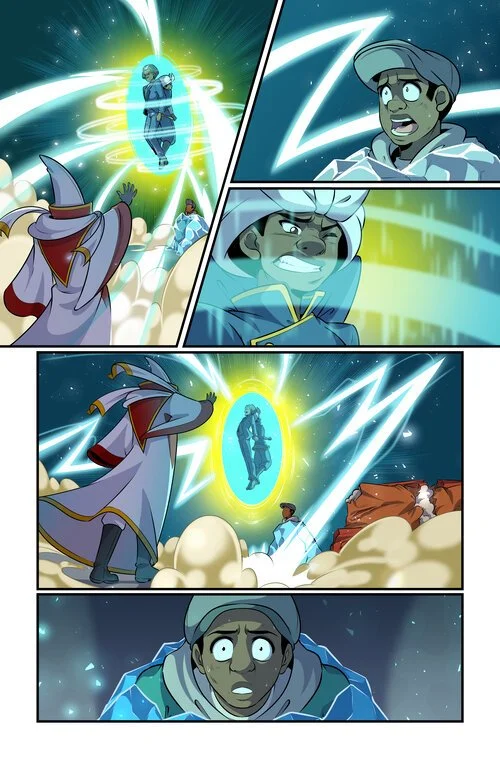
D.J. Kirkland was born and raised in Charlotte, NC, went to college in Savannah, GA and now resides in Vallejo, CA. He is the artist and co-creator alongside writer Daniel Barnes of the graphic novel THE BLACK MAGE published by Oni Press.
I love all of your fan art! Have these illustrations led to jobs for you? How important is fan art to you?
Well, thank you! Fan art has absolutely lead to jobs for me. A few years ago when I was unemployed, I did a lot of Super Smash Bros. fan art and posted it online. I ended up making those designs into t-shirts. Not only did those shirts sell pretty well, but it significantly increased my online following. I owe my career in comics to it.
What's it like working on licensed books? Also, I think it's important to maintain your own voice while producing work, do you get to do this while working on licensed projects?
Working on licensed books is pretty similar to working on creator-owned books except your work goes through another level of approvals before you can say you're done. In my experience, it's about finding the right balance of making sure the characters are as close to the original design as possible but also, putting your own little twist on it. They hired you because they want to see your take on their characters. So while you might not necessarily see "your voice" in the drawings of licensed characters you're working with, but your shot choices, panel layouts, color choices, and writing can definitely shine through in the work.
As a Queer Person of Color ( QPOC) have you had to work harder to be seen in the comics community?
I'd say so for sure. While the projects I've been hired to work on aren't explicitly queer, I'm hoping that with the work that I've done in addition to being visibly and unapologetically queer online makes an impact on other QPOC trying to get into comics. With comics being mostly cis-het, there are so many more queer folks in the industry now than ever before. While I am black and queer, I still benefit from being a man in the industry. So it's very important to me to uplift and support non-binary folks and queer women of color. I made a promise to myself when I was still in art school which at this point, was almost 10 years ago-that promise was if I'm ever in a position to uplift my peers or people in our community that I would do everything I could to help them get their foot in the door. It isn't a competition. There's room for all of us!
Branding! You hove quite the social media following and engage in a lot of discussions. How has your presence helped or hindered your work as on artist?
Social media has been an interesting field to navigate, to say the least. I'm looking at you, Twitter. I can only speak for myself here but I'd be lying if I said that it hasn't helped me get jobs because it absolutely has. Seeing hundreds or even thousands of people respond positively to your work feels good! Where it begins to be problematic is when you start basing your worth as an artist on the number of followers you have. You are more than your artistic output. You are more than your follower count. Those numbers are not a barometer of success. 10,000 followers don't equate to 10,000 sales. The large following has absolutely helped my career but it's not the only path to success.
I think that The Black Mage is on incredible work and I appreciate you educating and challenging your readers. Were there ever moments where you had to walk yourself back to accommodate for your audience?
Thank you! I love the work that Daniel Barnes and I did on Black Mage. Surprisingly enough, we received very little pushback through the development of it. Early on, we went through several revisions of the story outline and the first chapter. It wasn't because of us having to walk anything back, either.
I believe that our publisher knew the importance of the subject matter and knew that our story needed to be told, and they wanted us to tell it to the best of our abilities. Ultimately, It was well worth the number of revisions. Daniel's writing got stronger with each pass and I also had more of a say in developing the story as well. By the end of the scripting process, it became less of a writer-artist relationship and more of a co-creator relationship where I did the heavy lifting with the art and Daniel with the writing.
What was it like getting your first book published? How long was the entire process?
It's a pretty surreal feeling honestly. I never thought I would get to this point. I got my BFA in Sequential Art at SCAD in 2009 and Black Mage didn't come out until 2019. Black Mage's development is honestly a blur at this point. Most graphic novels don't take as long as ours to make. We started writing the book in 2016. I started drawing it in late 2017, and all the art was handed in February 2019. Then Black Mage was finally released on October 29th, 2019. It's been a long road to making this dream come true but ultimately I’m grateful it happened when it did.
Any advice for a cartooning major that's about to graduate from college? Feel free to be as real as you wont ...
Alrighty! Let's be real about this.
Don't expect to get a job doing comics right out of college. It’s super uncommon.
Don't expect to be paid a lot of money doing comics. If you're expecting to make a lot of money in comics, you're in the wrong field.
It's totally fine to hove a day job to help supplement your career in comics. Having a steady income and your bills paid is important.
When you do land a job in comics learn how to read your contracts. Also, hove someone that understands them to make sure you're not getting a bad deal.
Stop redrawing the some comic pages over and over again. Publishers want to see that you can tell a story, not how perfect each panel is. Done is better than perfect.
Dress for the job you want: If you want to do interior pages, actually have comic pages in your portfolio. If you want to do covers, show illustrations. If you want to be a colorist, have examples of colored work.
Draw things and tell stories that you're actually interested in.
Work in CMYK if you plan on printing your work.
The comics industry is small and people talk. Don't be an asshole online.
Learn how to do your taxes.
Favorite tropes or themes to put in your work?
I love a good tournament arc. I love themes about overcoming adversity and defeating the forces of evil through the power of friendship. So basically, shonen anime themes.
Digital vs traditional thoughts? Why do you use the programs you use!
I don't think it's a "vs" situation. I think both hove their advantages and disadvantages. I moved to all digital because, at the time, I didn't have space to house all of my traditional comic-making materials nor a large format scanner to get them on a computer. Going digital eliminated a bunch of extra steps I hated dealing with when it came to traditional work. I use Clip Studio Point for all of the art-making and Photoshop for color corrections and formatting.
What was your experience working with editors? Do you have an agent?
I’ve worked with an editor for all of my published work and it's been a pretty easy process. We have an open line of communication so whatever I needed, I let them know and they've been able to help me wherever they can. I don't have on agent yet but I’m actively looking for one now!
Much love to D.J. for sharing his wisdom! Check out his work on Twitter and Instagram: @OhHeyDJ www.djkirkland.com
INK would like to thank D.J. Kirkland for taking the time to be interviewed!
psst! check out the Spring 2020 Issue to see this interview in print…