Tom Bloom
Fall 2023 Issue
Interview by Adam Jones
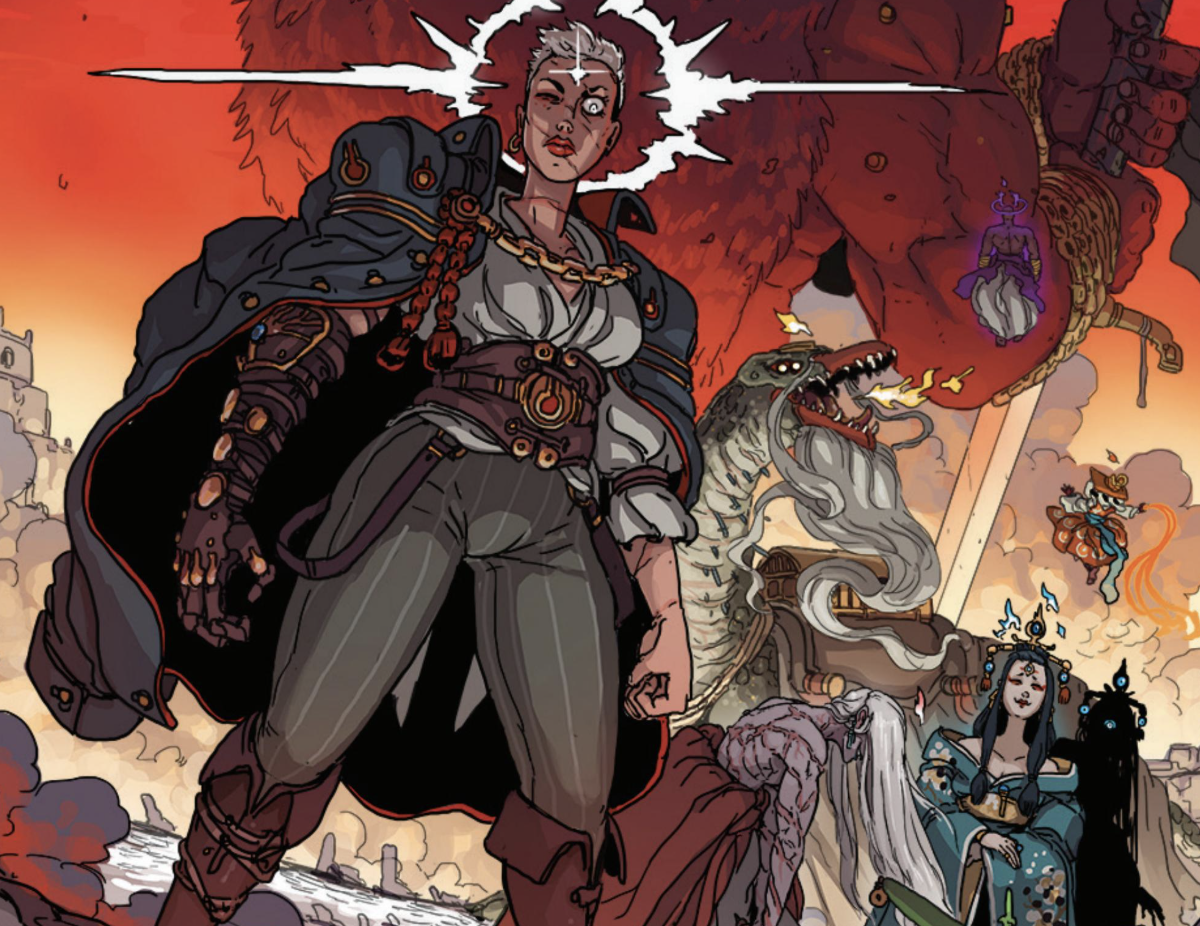
Tom Bloom is a webcomic artist from the UK who draws from his home in Atlanta. For nearly a decade, he’s written and illustrated Kill Six Billion Demons. He also designs tabletop roleplaying games, including Lancer and Magnagothica: Maleghast. Tom’s intricate and fantastical art has earned him legions of followers—including me! I hope you have as much fun reading this interview as I did conducting it.
What was your early work like? Did you have any formal training, or were you self-taught?
Oh, I had no formal training. I took art in high school, and I drew a lot of comic books for online comic competitions. I think my first one was in 2006, on a spin off of the Penny Arcade forums in 2006. So I got into that, and also did OCTs on DeviantArt back in the day.
Could you explain for those who might not know about OCTs?
So an OCT, or Original Character Tournament, is a large early internet thing. You take a character, and someone else's character, and you both draw comics of them interacting. Typically, it’s some sort of crazy anime fight. Then people vote on the outcome, and people move forward in the tournament until there’s one person left.
The thing about them that’s so cool is, they foster a large community. You immediately get this group that reads your comics, encourages you to make more, and gives you feedback. You also end up producing a lot of comics on a tight deadline. So when I was sixteen, OCTs were addictive to me. I would just keep doing them. I wasn't even inking anything, just pencils and posting.
I'm still in contact with people that I was in OCTs with in high school, man. I play RPGs online with Ben Fleuter, who does a webcomic called Sword Interval; I met him doing OCTs in high school. Kelly Turnbull, who’s now a director on Cartoon Network, was a finalist in the Colosseum OCT with me. I invited her and her husband to my wedding, actually. I run into people at cons from those days who say, "Hey, I was in this, I was that character." We remember each other.
How does it feel to run an OCT now?
Yeah, I ran two OCTs recently. The first one was pretty good, I feel. The second one was really good, but also huge. It was probably—and I'm not being hyperbolic when I say this—the largest OCT anyone's ever run. Our Discord server had sixteen thousand people on it. People Make Games, the YouTube channel, ran a video on it that got 3 million views in four days, so we got a lot of attention. Every round, we had about 300 entrants. There was this crazy war game attached to it, called “War for Rayuba,”
I think in the end, I wish I had had more moderation tools to make sure people had a healthy experience. People got so invested in the OCT and drew so many comics, it was burning them out. I think there were literally thousands of pages of comics made for it, or tens of thousands. It was nuts.
That kind of small community has disappeared in favor of larger agglomerated communities that are more algorithm based, right? It used to be that you’d go to a site's forums, and you'd know everybody there. Now everyone who's doing comic stuff is on Twitter or Webtoon. It's pretty anonymous and weird. But you can still run an OCT. I think Discord is good for that because it replicates that small, insular community experience, which I really like.
Before it had its own website, you ran Kill Six Billion Demons as a choose-your-own-adventure story on the MSPA [MS Paint Adventures] forums. What was it like to give readers control over the story in that way?
I really liked Problem Sleuth. I think Andrew Hussie is one of the most instrumental people in webcomics, because he really pushed that mixed medium thing by making comics with Flash animations, games, and user interaction. It played to the strength of the Internet, right? You can put an adventure game in the middle of your comic. He would constantly do stuff like that. Problem Sleuth riffed a lot on old adventure games, and its user choice thing, where he took suggestions and improvised to a degree, was really interesting to me. So I thought I’d try it.
I found out that it’s impossible to tell a cohesive narrative that way, but it was good to have people read and immediately respond to my work. It gave me a lot of motivation to continue working. I went, “Well, I'm going to restart this without user input, and I'm just going to tell a story." But, the start of that was just being able to make work, which I think is the most important aspect of comic books.
What’s it like to work on a long-running comic like KSBD? Have you had to adjust your expectations about where the story would go at all?
It's a bizarre thing to work on something for this long on a single project like this. With most kinds of creative work, you can be done in a couple of years maximum. But if you're writing a book series or a comic series, you're just stuck. You're kind of screwed. Like, George R.R. Martin wrote the first Game of Thrones book four years before you were born. And he's not done yet. But you’ve got to cut the man some slack, because he's been doing the same thing for thirty years!
You start going, "Oh my God, why am I still working on this?" You then find entertainment in focusing on whatever’s going on in your work at the time. If you read any long manga series, you'll find the author gets tired of concept X, and gets fascinated with this other thing, So they put an arc in their manga where all the characters go do this new thing, right? In One Piece, they'll all go to beach islands, because Oda's interested in the beach, or whatever.
I’ve never changed my expectations of the comic as far as the actual story, because it's always been cohesive to me. I've always known where it’ll go, and it's weird now to be getting to the end of it. Imagine you have an idea and then you get to do something about it eight years later, right? It's a bit surreal.
Everyone always asks if I'm making things up as I go. I wish I was, because it makes things easier, but I'm not. I have an outline, which is quite detailed, but not to the level of individual story arcs or pages. So when I get to those pages, I have room to be creative, and not be beholden to my past self. All the stuff happening now in the comic, I outlined in macro six years ago. Then I went more in-depth about four or five months ago, and for the last couple of weeks I’ve been doing thumbnails and pages.
I don't write any dialogue until I get to the page, by the way. I write no scripts, because I'm not a writer working with an artist. I go panel by panel, putting down words and drawing the page around the dialogue. Some people are shocked, but that's how I work. Just draw the page, you don't need a script for that! Why do double duty, man?
One of my favorite parts of KSBD is the lore throughout it, like the short stories and the psalms on the website. What led you to add that to the comic?
It came from having a site and being able to put metatextual stuff on it. Why not, right? Sometimes I don’t want to waste comic pages on a small detail, but I’ll happily write a little blurb about it underneath! It’s a form of worldbuilding to some degree, which is nice because you don’t have to read it if you don’t want to. You can just look at the comic. I got that from reading fantasy fiction in high school, like Ted Williams and Brandon Sanderson. At the start of every chapter, they would have a little lore quote from somebody or other. So I was like, “I need to do that.” It opens things up, man.
Do you have any advice on how to balance your work with your life?
Comics is a strange profession, because it's one of the only mediums where you can do everything yourself. You can make what you want and you're not beholden to anyone in terms of schedule or vision. When you read a comic, you feel like it’s what somebody wanted to make. There are compromises if it's a big corporate thing, like a shonen magazine, but there’s still that feeling of "I have a cool idea, here it is." Even with guys at Marvel with deadlines, no one’s thinking "Ah shit, man, I've drawn thirty hours of Spider-Man." They're like "I'm drawing Spider-Man, this is awesome!"
It can be very dangerous, because you could find yourself doing what I did when I was your age, which was staying up ‘til one in the morning finishing pages. When I moved in with my wife in Atlanta, She'd be like, “What are you doing?” Well, finishing pages. People would invite me out at ten o’clock on a Friday, like, "Come out, man." I can’t! I’m drawing funny books for the Internet, all right? Everyone through COVID had to adjust to work-at-home situations, and I was in the pool already, you know? The water’s cool, I’m fine!
I think it's important to have regular working hours and stick to them. I have a deadline every Friday that’s self-imposed. Nobody is telling me to post, and I've done it anyway, and that's been good for me. I have a two year old son, y’know, who I watch for part of the day, so I have limited working hours; I clock out after 4:00. When you don't have that, it can be tempting to go, “I could just keep working now.” But you shouldn't! You should go cook, watch some anime, go for a walk, go outside, you know… smoke some weed, do whatever you like, just work part of the day, man.
You have to learn how to pace yourself. You’ve got plenty of time to make comic books, man. In the long term, the most important thing is consistency. My comic is seven hundred pages now, and the only way I did that was by doing it every week for eight years. You can’t do that in a shorter time, ‘cause either it’ll be bad, or you’ll destroy your body. I don't think anyone realizes how brutal comics are. It’s unrewarding too, because you spend eight hours drawing one page, and someone looks at it for ten seconds, and they go: "Cool, man. When's the next one?" And you go, “You bastard! Do you know how long it took me to make that?!”
I love your character designs, not just in KSBD, but everything you make. How do you conceptualize them?
I daydream all the time about stuff, right? Everyone, not just artists, has this thing where you see something and your brain tingles and you go “ooh.” The difference is that artists have a disease where they do this and have to spin it. They make something and go “Look at this! I saw a leaf once and it made me think about this.”
You gotta go outside, is the other thing. Don't stay in your bubble of comfort. You gotta go walk around, see people, and experience shit to make good art, man. The more input you have, and the more that input is what you’re interested in, the better output you’ll have. I find a lot of people think about character design from the other end. They go, “Oh, I want to make a thing like that!” and try really hard to fit in a mold.
I think people worry too much about how a comic will be perceived by an audience. Like, I think Webtoons are cool, but I definitely see a lot of people say, “I have to make comics that are gonna do well on Webtoon.” Dude, don’t do that. Just make the comic you want to make. You have to accept that whatever you make might not be popular, but it’s definitely gonna be way more interesting and engaging to the people that like it if it’s authentic to what you’re trying to do, even if it’s a bit weird or niche.
For example, I love 70’s and 80’s Shaw Brothers kung fu films, and xianxia films from that period. You’ll see a lot of my shit for KSBD comes from Chinese fantasy, which I will consume endlessly. I like old samurai movies and old westerns, I like weird-ass films, like Five Deadly Venoms and The 36th Chamber of Shaolin. I really like Heavy Metal magazine, and I listen to very heavy metal all the time—like goregrind, just brutal shit. I condense all these things down and get ideas from them.
I’d say KSBD throws a lot at the reader right out the gate, but it never feels impossible to interact with. Has it been hard to trust your audience to engage with the story on its terms?
I’ve found that people’s critical reading is pretty bad, en masse. That, or they hyper-analyze it. With the Internet, where people fixate on stuff, and decode it for clues instead of taking the work at a thematic level…people like to rationalize work that isn’t really meant to be rationalized. Like, I’m a big David Lynch fan, and god help you if you want to figure out what any of David’s work is about. It’s about creating an experience, which he’s very good at. But unfortunately, some people are like, “I need a YouTube video essay to explain to me what this means.”
“I need to Google the plot of Mulholland Drive—”
Yeah. A lot of those people can’t get a theme if you beat them over the head with it. There are people who say, “If your character is doing something immoral, that means you’re immoral. And I hate you.” And other people who say, “I don’t like this character because they’re doing stupid things.” Well, that’s the point. The character isn’t very smart.
I certainly listen to good-natured criticism. I’ve found it helpful over time. But it’s important to remember that not everyone reading your comic has the same views as you, and they might differently perceive something that you see as very obvious. So just make what you want to make, man. Let the chips fall how they may.
You have to trust your work and not respond when people have negative feedback. I had an arc in my comic about nihilism. In it, an omniscient woman tells the main character that life is essentially pointless, you will die and be forgotten by everyone you’ve ever known. She’s omniscient, she can’t lie. And the protagonist witnesses the universe in all its glory and sees this lady is telling the truth. And I still had people go “Well, she’s lying. She’s trying to manipulate the main character.” And I’m like, no, the point is that she’s not. I had to be so on the nose about that, and people wouldn’t accept what the text was literally telling them.
I think it was important to have that arc because it thematically underpins the point of the comic. But people who read this as a big shonen battle comic—which it is partly—were expecting something different, and didn't like having determinism thrown in their face. Of course that wasn't everybody, and I had lots of people come to me afterwards saying, “Good arc, really liked it.”
A friend came to me with some writing recently. She wrote this character who had a big, awkward fight with their significant other. It's nasty, it's cruel, they break up, and they don't see each other for months. Everyone read that and went, “Oh, my god, that's so harsh. I hate this character.” She asked, “Should I change this?” No, that’s drama, dude! Just because people don't like that—you don't want them to like it. You want them to want the catharsis from that. You have to let people sit in discomfort. It was the right thing to do.
It feels like you defy a lot of standards people assign to fantasy stories. What’s your own philosophy with regard to storytelling?
A story should focus on the characters and their personal experience. I think the plot is the weakest possible thing. You can write something great without plot, especially in comics, which are such a visual medium. People suspend their disbelief when it comes to all that. You can screw around with that stuff.
What people will not forgive is when characters are weakly written and nothing compelling or intriguing is happening. There should always be tension of some kind, an attempt to resolve it, and a new tension that makes you say “What’s happening over here?” You need that feeling pulling you onwards. I think there’s a lot of recent media which is very anti-conflict. Shows like Ted Lasso kill me because they’re so uninteresting. They just lack pathos, man. They lack drama. I need some nastiness in my stories.
In fantasy, the world should be a character, and there should be a sense of place and time and experience. So much of modern fantasy is overly explained and commodified. Brandon Sanderson writes fantasy stories that people like, but there’s nothing in his setting that’s a weird space. And that’s what is compelling about fantasy, that sense of discovery.
What would you tell someone who hasn't made a comic and wants to know where to start?
It sounds facetious, and a bit cruel, but the only way to make comics is actually to make comics. No amount of character designing, writing, illustration, sketching or anything else, will ever make a comic book for you. And the only way to get better at making comics is to make comics. It's a physically ingrained skill. You have to wear a groove for it, If you don't roll that wheel along, even though it weighs 500,000 pounds and you’re rolling it five hours a day, you're never gonna learn that groove, and it's not gonna get easier.
I don't want to undersell how hard it is to make comics. It's a very labor-intensive process, man. People look at a page, which takes four to ten hours to make, and—one of the spreads in book three I literally timed it; it took me 135 hours to finish this four page spread.
If someone came up to me and asked, “How do I learn to play piano?” I'd say, "Well, you better start practicing." You just gotta play. You're gonna suck, you're gonna hate it, but you're gonna learn the fingerings, and you’ll get better at them, and you’ll be able to sight read, and then it's gonna feel really good to play piano.
You just have to make comics. Do the pages, get a twenty page comic together, get it out of the way. Cool. Now you have a comic. Forget that comic by the way, you’re not gonna like it later. But get it out the way, do the next one, and just keep doing that.
If you draw a graphic novel of a certain quality, and it's over 150 pages…Image Comics will publish you, man. They pay you on residuals, on profit. So if the book doesn't make any money, you don't make any, but they will publish you. I talked to a good friend of mine, I said, "You should finish a comic and pitch it to them." And she finished a webcomic called Ophiuchus. Published it with Image. Took her two years. So, you can do it, right? That’s what I tell people. “Just finish the comics!”
Tom, thank you so much for taking part in this interview with INK! Find Tom on Twitter as @Orbitaldropkick, and read his comics at killsixbilliondemons.com!
psst! check out the Fall 2023 Issue to see this interview in print…