Tillie Walden
Spring 2022 Issue
Interview by Heather Mann
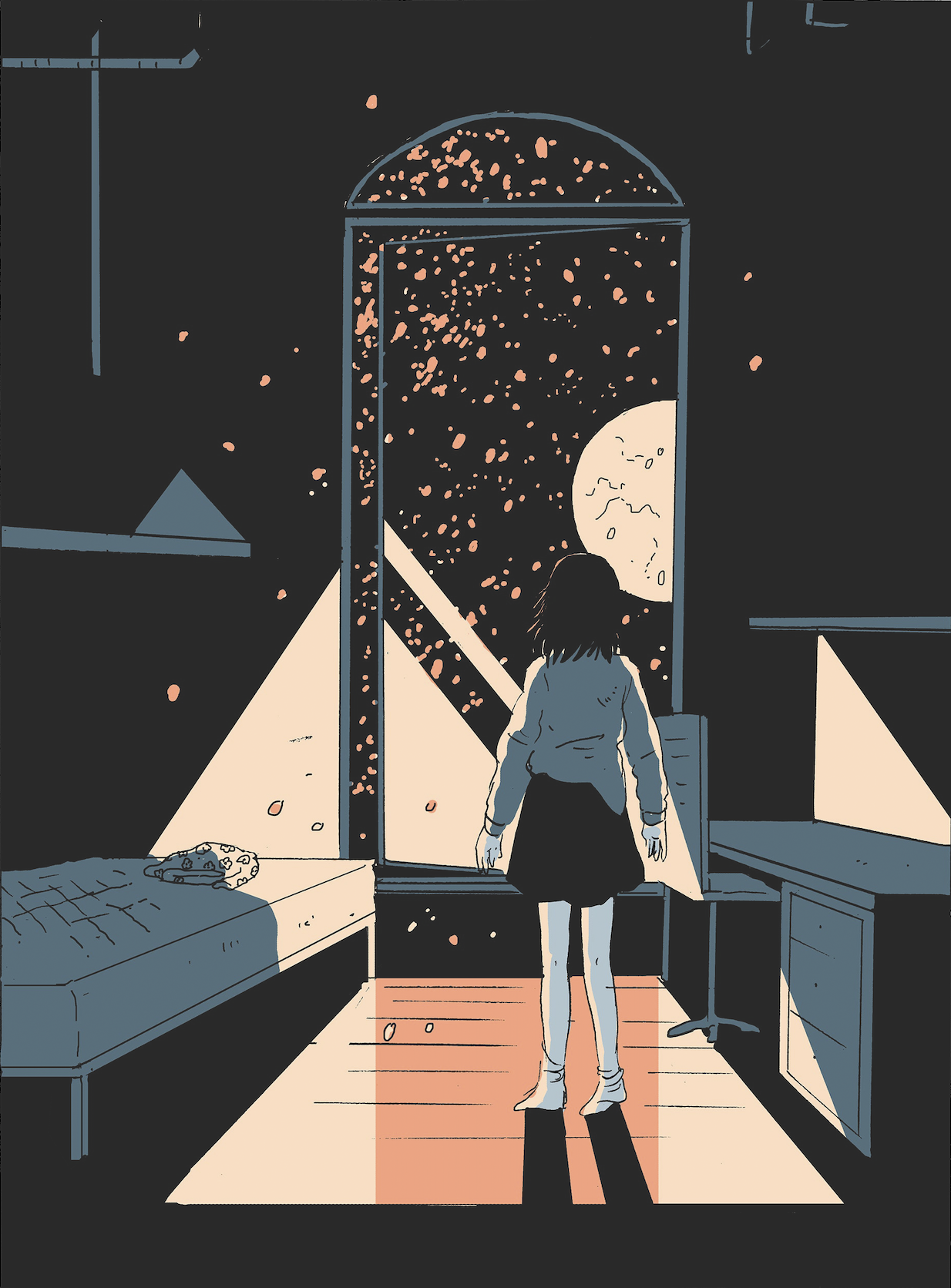
Tillie Walden is an American cartoonist who graduated from the center of cartoon studies and went on to publish five graphic novels and one webcomic. She received an Eisner Award for her autobiographic work Spinning and now teaches at her alma mater while continuing to work on comics.
The story behind On a Sunbeam fascinates me. I love how you were able to create something beautiful and engaging from a genre that is typically male-dominated, and as you’ve mentioned, previously unfamiliar to you. How were you able to motivate yourself to work on a story that was created from your "perpetual disappointment and boredom towards any story set in space", and what advice would you give to other artists looking to step outside of their comfort zones?
Haha, did I say that? I sound very bitter, haha! Well, I think it’s easy to step outside of your comfort zone when you’re not stressing about the end result. I was never making OAS to try to make something important in the genre of sci fi, I really just thought it would be fun to try. That’s been my motivation in everything I draw and make - it’s about the process, not the finished product.
So I think I motivated myself by thinking about how exciting it would be to try to make a story in a way I hadn’t before! It never really scared me. I have a lot of fears, but they don’t really revolve around drawing! I also think that even though I wasn’t too into sci fi for a long time (though I’m getting more into it now) there was something about it that DID stand out to me - the DRAMA, the HUGE visuals (space ships??? They’re gigantic!!!) I love anything that’s giant, I’m such a sucker for vastness. So I tackled OAS as a way to draw out what I had seen before in sci fi stories, and make it my own. And I already said some advice-like things above, but really, genre doesn’t matter, why worry about it?
Worry about the roads in your town, don’t worry about making something that would come across as true to a sci fi fan. Genre is ever-changing, and fluid, and open. Anyone can enter it and do with it what they will. Some hardcore fans might disagree with me, but why else make comics except to draw things that are fun?
One of my favorite parts from Are You Listening is the spread on pages 36 and 37. They completely depict the moody atmosphere and tone of the conversation while smoothly and abstractly showing the passing of time. Temporal transitions like this are often difficult for many cartoonists, how do you go about visualizing and illustrating these types of scenes?
So for transitions like that… I think a lot of it comes from the fact that my stories are very unplanned, so when I’m drawing, I’m discovering the story with each panel, each step forward. And oftentimes, I have no idea where I am, really, so I rely on drawing slow/moody transitions as a way to sort of… wander through my subconscious? To discover what it is I’m trying to say? And in a more practical sense, in my sketchbook I’ve done a lot of drawings that sort of melt into one another, and I’ve discovered I really love how visuals look when they collide and interact as if space is made of liquid.
I Love This Part will forever be close to my heart. I picked it up at a comics shop in Union Square just because I thought the art on the front cover was beautiful. Little did I know, I was in for some sniffling and tears when I got home to read it! In all of your works, you're able to create extremely life-like stories with characters that feel believable. Do you have any tips for writing characters that are as realistic and relatable as yours?
That’s so kind of you to say! That book is close to my heart, for sure. Tips for writing real and relatable characters… well, honesty is a big one. Even if you’re writing fiction, trying to incorporate feelings you’ve actually felt, getting specific about what they meant to you, does most of the work. That doesn’t mean every character you write has to be YOU, but it does mean that when you have a personal connection to something in your story, it can bring about a lot of light. But outside of that… god, just give the reader something to ROOT for! There’s nothing more compelling then a character trying to reach for something (love, acceptance, you name it). So don’t give your characters an easy time, always. Challenges help us become who we are, and the same is true in writing!
You published The End of Summer back in 2015 with Avery Hill Publishing. Since then, you’ve gone on to work with First Second on works like Spinning and On a Sunbeam, as well as Skybound Comet for your upcoming trilogy Clementine. How has your experience been working with multiple different publishers and editors? Has the process varied based on the content of the book and the company publishing it, or were you ever given free rein to create what you wanted?
Ah I’ve worked with so many wonderful people, I’ve been very lucky. I’ve always really had creative freedom, I don’t think people choose to publish my work in order to change it, my editors have always helped my work become more my own. But again, I’ve been lucky. It’s certainly been a whirlwind, all these damn books. I’m exhausted, honestly. I told my wife after I finish up Clementine and another two books that I’m quietly working on as well, I’m gonna take 5 years off… but then I’ll get back to it.
What advice would you give to novice cartoonists who are looking to break into the professional publishing world? How do you make your work stand out to editors?
Hmmm, standing out is hard these days. But lets see. The only way to stand out is to make a TON of stuff. Draw comics constantly. 1 page comics, 5 page comics, 30 page comics (work your way up to graphic novels, don’t start with them!) The best thing I did for my career was spend a year doing nothing but drawing on my own, trying to get better each day, and posting little bits of it on the internet (twitter.) Finding success in comics takes time, as with anything.
What’s more important than standing out to editors is that you truly try and hone your craft. Think of how someone learns piano. They don’t start performing right away! It takes a lot of training to get there, and the same is true for art. If you’ve never made a 50 page comic, but you already think you want to be a cartoonist, do something for me. Sit down, spend the next three months and try and make a finished 50 page comic. If you have a horrible time, this might not be for you. But if you have so much fun, then… well, keep drawing. Keep trying to improve.
Post it online if you want to, go to comics shows, read comics, also don’t read comics, read books, watch movies, and learn other skills. Seriously, it’ll make your comics better. Wow I’m just going off on one, aren’t I? Ultimately, making comics professionally worked for me because I was willing to put in hundreds of hours alone at my desk. I made probably… 200 pages of comics at least before Avery Hill found me to make TEOS. And the time I was making comics BEFORE I found my publishers, before this became my job, was the happiest time. Don’t rush. Enjoy drawing, someday, someone will see it, and it will mean something to them.
Any final thoughts or words of encouragement for the young cartoonists of the world?
Gosh! You can do it! I really think you can! I made comics because nothing else in the world made sense to me, and I’ve spent years using comics to try to put my life and head into a sequence that makes sense. It’s all a beautiful journey. It’s so hard sometimes, it’s so stressful, but this is a great goddamn medium, and cartoonists are some lovely people. Come join us.
INK would like to thank Tillie Walden for taking the time to be interviewed!
psst! check out the Spring 2022 Issue to see this interview in print…