Spring 2025 Issue
Interview by Noir-Monet Purviance
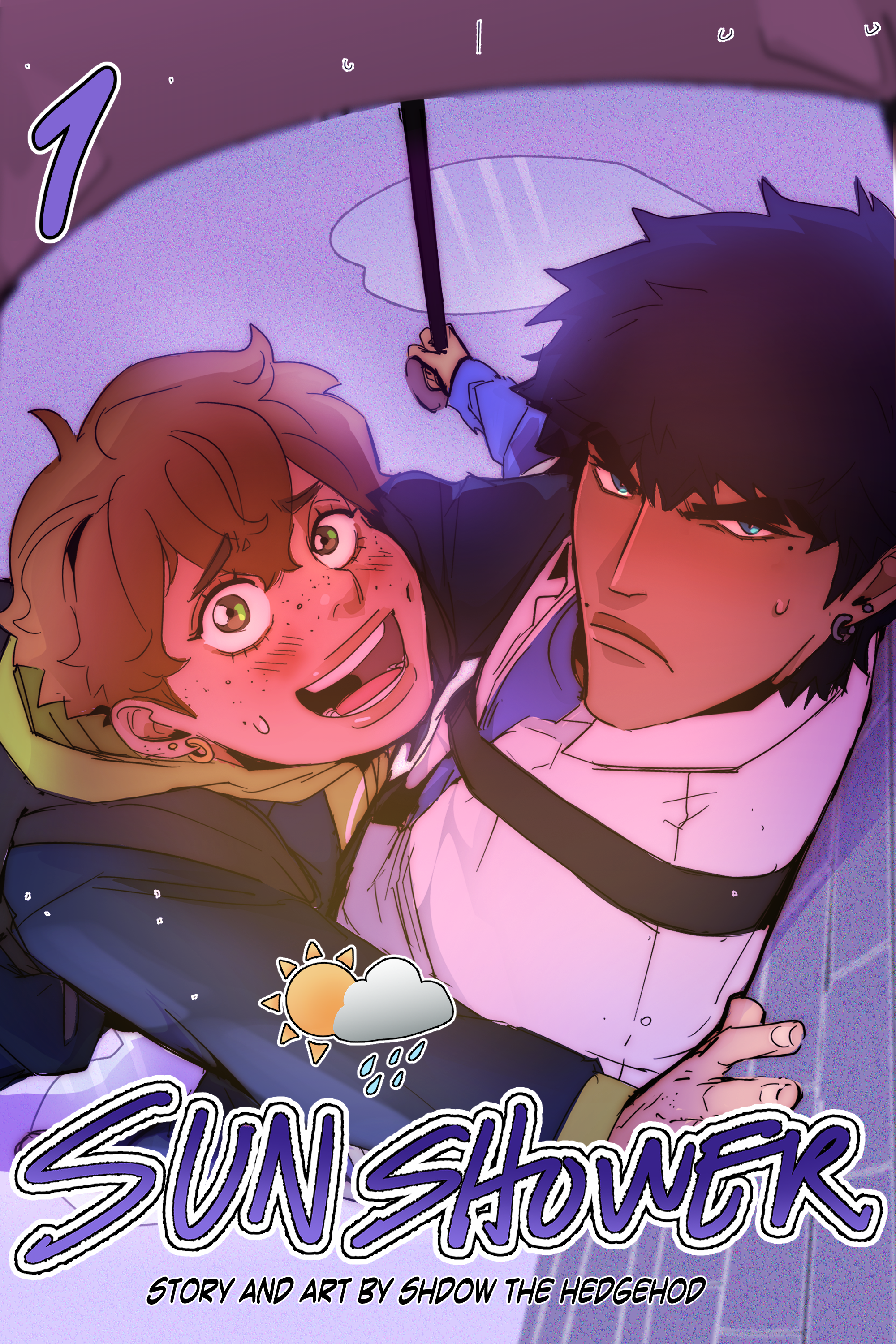
Racketballs is a twenty-seven year old cartoonist from Florida. She has been publishing her webcomic Sunshower on Webtoon since 2019, having since amassed a large following online with over a hundred thousand followers on Instagram, and a thousand followers on her Patreon. Aside from her endeavors with publishing her own comic, she is also known for her work as a Powerpuff Girls fan artist.
Noir: Awesome. So hi! I’m really excited to be interviewing you. Thank you again for accepting—and you know, just being super willing. I’m really happy because I’ve loved your art for a fairly long time. Literally since 2019 when you started doing Sunshower.
Racketballs: Oh, really? Yay!
No, yeah. Very big fan. So this is, like, amazing for me. The first question I have is just about your experience as someone who posts a comic on Webtoon—and I think you also post on Tapas, right?
Yes. I post on both just because they’re available to me. Some Webtoon artists are, like, affiliated with the company. I post on Tapas and Webtoon Canvas, which are free for anyone to post on. But I’m the only person behind Sunshower—so I get to have full control over my assets, writing and everything behind it. So it’s not really affiliated, but I do post on those, yes. I get paid in ads sometimes; based on the influx of readership and my audience, but that’s it.
And then similarly in that vein, since Webtoon is very mobile based, and not set up to be read like an actual comic—you have to scroll and everything—do you think that the format of webcomics is limiting to you as a cartoonist? Something that I really enjoy about your work is your paneling, which reminds me of traditional comics, and not the Webtoon scrolling-type comics.
Yeah. When I first started, I had a huge qualm about the formatting of webcomics. Because I’m, you know, I’m older. I wasn’t into webcomics when I was a teenager, and a lot of the concepts of Sunshower were about teenagerhood, or childhood. So I wanted to keep aspects of it, because a lot of it is inspired by traditional comics; things that I read when I was younger. So that was like a huge hurdle because I wasn’t into the scroll format. I ended up sticking to the comic format just because it’s, you know, the way that I wanted it to be perceived. It was a lot of “what would be best for my readers?” I wanted to stick to what was true to me—I really like composition work, and setting things up where there’s a lot of space being taken up. With a lot of scrolling formatted comics, there’s so much empty space. And I wasn’t into it.
Totally. That makes sense. I read webcomics occasionally, like yours and a few others because of the stories obviously, and because I enjoy the formatting of them. Your comic reminds me of traditional comics; panel-to-panel, western comics, and manga-esque stuff. I’ve always found the Webtoon format, and just the scrolling format to be very void sometimes. What kind of comics did you grow up reading that informed your style of comic making?
So I think even as an adult, my comic career is kind of expansive. But right now, I would say for Sunshower specifically, I read a lot of shojo manga and stuff when I was in high school. Like in the library, I would just pick up a random shojo manga. So you can see a lot of inspiration from that. I know when it comes to certain textures, and maybe even, like, the way I allocate lines—I read a lot of action and DC/Marvel type comics as well. So I was into a lot of that when I was way younger, like when I was a kid. But as I was nearing high school, I really liked romance and slice-of-life-type situations.
Aside from shojo and other inspirations, where did the story come from specifically? What was the process for coming up with the story of Jamie and Noel and all the other characters?
So actually, my friend wrote a first draft kind of thing. And it ended up being a story that they didn’t quite like…but I really enjoyed the pacing of it. And at this time, I wasn’t into comics or anything. I just wanted to kind of adapt the writing style that they were doing. And over time, I got really attached to the comic process. Sunshower was not originally a project that I would stay consistent with at the beginning—I kind of just threw it out there because I wanted to learn how to do comics. I really just wanted to learn. So I decided to adapt their writing into comic format, and it just went from there. I just took the story cause they no longer wanted it. They had a little blurb, and I was like, “Sick, it’s mine. Thanks.”
So it was basically like a work in progress as you were posting.
Exactly. I didn’t really come out the gate thinking it would be successful, or anything I could have any sort of longevity with. I just wanted to learn. Sometimes I try to put myself out there a little bit and try to learn as much as possible if I have the ability to. So that was what I did. That was a long time ago, though, 2019.
I remember I saw a drawing of Jazz, and I was like “Oh my God, this character design is super cute,” and I had made a screenshot of him my profile picture on social media. And I literally caught up with the comic in like…a day. I was extremely obsessed with the storytelling and everything about it because I thought it was really, really well done. I also really love slow-burn stories. And I feel like you do that very well.
I also like a slow burn, maybe a little too slow to some people, but I think it helps especially when it comes to paneling and pacing.
Last year you came out with the first print of the first chapter of Sunshower, and you redrew the entire thing. Why did you, and what was that experience like? Was it revelatory to go back and see all of your old work compared to your current stuff?
Yes. So the reason why I redrew it is because I absolutely didn’t want to print the original. Not because it was bad, but in hindsight, I’m looking at it and I’m like…“That is not to be printed and sent out to people who care.” And I care a lot about how my art is perceived. I wanted it to be looked at the way that I thought it should be appreciated, I guess. So I worked a very long time to redraw everything from scratch. In a lot of my work, I think I do a lot of redrawing and rehashing, because I want to kind of keep improving. And as an artist, it’s like—you’re learning for the rest of your life. So yeah, that’s one of the conceptual aspects of my life. So I wanted to redo it, and I kind of used similar things that I did in the first round that I used in the second one, just because that aspect is important to me, and because I wanted to be inspired by myself this time a little bit.
Do you think it was also kind of self-indulgent for you in a way to redraw it all?
Oh, yeah. It was a very selfish decision, to be honest. I was like, “No, I’m not printing the first one, because I don’t want to.” It was definitely self-indulgent. I don’t regret it, though, of course not. I really enjoy how it came out.
When I bought the first volume, I was looking at it, and for a minute I didn’t realize that you had redrawn it all, because I’ve gotten so used to seeing your art as it is right now. And so when I went back and looked at it on Webtoon, I was like, “Wait. I did not realize she redrew the whole thing.” But it turned out amazing and it’s beautifully printed. Since you printed it yourself, how was that for you?
Oh, it was a little bit of a struggle. Because I was not into printing. I think I actually have a horrible relationship with printers…printing is like the worst thing ever for me. So I had to learn a lot about formatting for comics—and again, I’m just a student for the rest of my life. But yeah, it was very difficult because I had to reformat for the bleed line and stuff. Sunshower was intended to be posted on the internet, so I wasn’t thinking about that the first time around, but that’s something that came into play for printing. But I ended up learning a lot. And now I’m really into printing stuff! So I don’t think I have to struggle too hard when it comes to printing something in the future, but that was interesting. I definitely had some nights though where I was like, “This is ridiculous.”
Were you using any programs like InDesign to help with figuring everything out for print? Or were you just doing everything manually?
I was doing everything manually. Which, I probably should have figured out some other way to do it, because it probably would have made it a lot easier for me. But I just used Clip Studio and did a lot of troubleshooting and problem-solving.
Honestly, the final version looks like you refined things in InDesign and had it printed. So I think it’s a testament to your work that it turned out so nice.
Thank you. The website that I used also helped me quite a bit when it came to reformatting. Because I’m not going to say that it came out, like, perfect when I sent it. I used Mixam when it came to printing, and they have somebody on board that fixes your little mistakes internally. I was like, “Thank God” because it is a bit difficult.
Do you ever see yourself working in publishing as an artist? Like, would you ever want to have an agent, be illustrating graphic novels for writers, or illustrate another story? Or wanting Sunshower to get picked up by a publisher. Is that anything that interests you?
Absolutely. Maybe not Sunshower, I think at this point it’s a little far into the process of it. To be honest with you, I don’t have an agent or anything, but I think that would be a cool opportunity. I’ve done a cover for something, and after that—my first experience with a commission cover—I was like “Oh, this is kind of cool.” So I think that would be really awesome if I could get picked up somewhere. But, you know, no idea.
As a Black artist in primarily online spaces, how do you feel that your experience as someone who creates art has been? In terms of your relationship with fandom spaces and just interacting with people. Because you make a lot of fan art, in addition to Sunshower.
Well, it’s a fighting battle sometimes, as you can probably assume. I think mostly I take it on the chin. I’ll be honest, there are very few times when I care a lot when it comes to hate or any sort of criticism when it comes to my work, only because I know myself as a person, and I know my intentions. I think it’s interesting sometimes; I really like fandom and stuff, especially because I’m very deeply interwoven in one—it contributes to a lot of my work ethic. At the beginning of fandom, like on Tumblr and stuff, the whole point is just to be seen and make things. A lot of it is quantity over quality sometimes. So those were my early days. And now I’m just like, well, I’ve put all this work into social media stuff, I can kind of be a little bit adventurous just because I’ve been doing it for so long. And because of that, I think when you go outside of the box a little bit, people feel a little upset about it. Which is fine. I honestly don’t take anything too personally.
I found you through your Powerpuff Girls fan art, which I feel like a lot of people definitely did. I really enjoy your redesigns of them, and your investment in the characters overall. Even though they’re not your characters in the literal sense, since you don’t actually own them. But do you think that your interpretation of the girls—and the Rowdyruff Boys as well—are an extension of yourself now? Like, do they feel as if they’re your original characters in some way because of how much you’ve invested into your interpretation of them?
Well, if it makes any sense, they’re less like original characters; it kind of feels like they’re little Barbie dolls. You know how Barbie is still Barbie, but she’s your Barbie, so she’s different from someone else’s Barbie? It’s like that. It also feels like a group effort, to be honest, just because I was in fandom and stuff when I was 15 or 16, just watching what other people did and then creating my own interpolation of it. Also, I think, yes—they are an extension of myself, which I felt for a long time was the reason why I didn’t show my face. Because I was like, “You guys are always looking at me anyway.”
What is your process for character design? To make your characters fun, unique, and interesting.
So when it comes to character design, a lot of my inspiration comes from fashion design, because—I mean, I didn’t go to any sort of fashion design school or anything, but that’s like my personal hobby. I collect a lot of magazines and a lot of fashion books that I look to for inspiration. So I think a lot of the decisions I make are based on silhouette. I’m really inspired by 60’s and 70’s fashion, so it’s a lot of shapes. But in a way that I would kind of make it my own, because it’s not exactly the type of inspired work you would see from 60’s or 70’s fashion, but kind of like an interpolation of that is what I put on my characters. As well as 90’s Black fashion and streetwear. So those are little things that I put throughout my work when it comes to character design. It’s a lot of clothes, fashion-based stuff that I like to indulge in.
Definitely. I know you said that a lot of inspiration for the story came from shojo and specific tropes, character archetypes and stuff like that. A lot of it can sometimes be corny. But do you think that veering into and indulging in the corniness of tropes and romance stuff is fun? I feel like in Sunshower, it’s very silly, and the humor in it is very palpable which makes it way more engaging to read.
I think because it’s so over the top, that’s what got me interested in it. When it comes to tropes, different topics, the over-the-top reactions, and the ridiculous relationship stuff, it’s kind of like how I thought when I was a teenager, a little bit. If I were to read a shojo manga now, I’d be like, “This is so long, it’s taking forever.” It’s a little bit inspired by parody. I really enjoy parody as a genre. I do enjoy the genuineness of the reaction. The kind of audience that Sunshower has is still people who are, like, fairly young. I think it’s a lot of teenagers who are reading it in a way that it’s like a shojo manga that I would be interested in when I was a kid. But it’s a lot of me in the background of it being like, “Well, they don’t know that I’m doing this later!”
Like a puppeteer almost.
Yeah, that’s exactly what it is. Or I’m like, well, “They have no idea what’s coming.” It’s a little bit of an inside joke—but at the same time, it’s like a love letter to the comics that I used to read when I was younger.
Yeah, another thing I wanted to ask about Sunshower is in terms of the character relationships, which one is your favorite in the story and why? Who are you most drawn to?
So my favorite characters are Daniel and Adrian, a hundred percent. It’s quite funny, because you know, when you’re reading these genres, like romance—it’s always the second couple that kind of catches your eye a little bit just because they’re moving a little faster. But because you kind of have rehashed the whole world out already with the first couple and dynamics, the second couple is moving in the background a little bit. So that’s something that I wanted to put in place. Those two actually, as I took Sunshower from my friend—Jamie and Noel were there, but the other two weren’t. So that, in itself, is my own writing. You can see it’s a little bit more self-indulgent when it comes to what they do.
I get it, because I’m not a main character person ever. I’m cursed with liking the side and background characters. So I was immediately drawn to those two, mainly because I love their character designs—but particularly Adrian. I’m a certified Adrian lover, I think he’s so silly and cute, and I feel like I’m very drawn to the “opposites attract” trope. Adrian and Daniel are kind of amazing in that regard. Like, Daniel on his own is annoying and I’m obsessed with him. But also, him paired with Adrian is perfect.
Yeah, exactly. I think as stand-alone characters, they’re a little more enjoyable; just watching them navigate the world separately. It’s like watching a train slowly get into an accident... just destruction nearing. And I also enjoy opposites attract. That’s like a theme of life too—I really enjoy juxtaposing dynamics throughout anything I do. I honestly thought at some point, like two years ago, that maybe I was overdoing it. Like everything I do has to do with concepts where the characters are butting heads, stuff like that. But I’m a complicated person.
Are you self-taught primarily? When creating art in general, is it just references and stuff that you personally find to be inspiring? Or do you have an art education?
I went to a community college in hopes of transferring to Ringling. But then I kind of reflected. By the time I was done with community college, I was 21 and I was like…“So I’m going to transfer and do my last two years at Ringling…I don’t think that’s good.” So I ended up just doing a lot of self-study because I felt like I was missing out on the art school experience that I really wanted when I was in high school. So every summer, I would focus on one thing to learn. I graduated college in 2019, so that year I learned comics, and that was Sunshower. But I think the previous year before that, I wanted to learn about composition. Every year, I try to revolve my art around one thing. This year, I’ve gotten really into environments, backgrounds, lighting—and I really want to encapsulate a vibe with everything. So I would kind of just like to give myself homework a little bit, because I didn’t want to fall behind when it comes to all these artists that are my peers since I didn’t go to any sort of formal art school. But I did take a lot of art classes at the community college that I went to.
In addition to doing studies, are there any specific artists that have inspired you? Whether they’re older artists, traditional artists, or online—who has informed your style and the way that you learn?
I think for formatting and comics, whether it be for action or romance, slice-of-life, whatever—I really looked up to Tite Kubo, who is the author of Bleach. I also was really into Avatar growing up as well. And I always look to those when it comes to inspiration. When it comes to composition, I really looked up to Kim Jung Gi a lot when it comes to draftsmanship and drawing things freehand. Who else…I think when it comes to different sorts of shapes that I use, I was really inspired by Robert Valley. The Spiderverse movies are cool when it comes to texture. So for every single kind of art fundamental, I tend to have some people.
Lastly, on the art course that you made—you started promoting it fairly recently. What led you to make a course for character development and stylization, and to start something that other people could learn from?
I think that I come from a unique perspective, a little bit, especially amongst the kind of people that are in my peer group. As I am independent from any sort of publishing, for one—but also the fact that I’m a Black artist and stuff is another. I also don’t really come from any sort of art school, I’m a little bit self-taught, and I think I’m disciplined to a very high degree. I feel like art is something that should be cherished when you’re making it yourself. Which is why, honestly, I’m a little bit possessive over some of the work that I make. It’s a very personal process. And I feel like everybody’s art should be a very personal and very cherished process. I think that because of social media these days, it’s kind of hard to navigate without getting too obsessed with numbers and people, and being like, “I hope somebody likes this,” blah blah blah, you know? It gets a little scary.
So I want to be able to kind of keep reiterating that it’s yours. The art that you make is yours. You made it from nothing. And I think that’s something that, as artists, we kind of take for granted. You made this from nothing, and you came from your experiences as a human being to make something. Whether it be something that’s self-indulgent, if it’s lame, or if you think it’s ugly right now—it’s still something you made.
That’s the reason why I wanted to make the course. Because these days I’m like, “Guys, take your art as something that should be cherished.” I feel like it’s something easier said than done, definitely. At the beginning of my career, like, the only person who was looking at my art was me, right? I think a lot of times, when you’re younger, sometimes people post online and they get a comment, maybe some people will see it—but the next post they make doesn’t do as well, and they automatically feel like they fell off or something. And I’m like, well, it’s not about what other people think. Again, a little bit easier said than done, especially since art is meant to be like communication and also about community. But I think if you’re happy with your work, it should kind of expunge all the other stuff.
INK would like to thank Racketballs for taking the time to be interviewed!
psst! check out the Spring 2025 Issue to see this interview in print…