Meredith Gran
Spring 2016 Issue
Interview by INK team
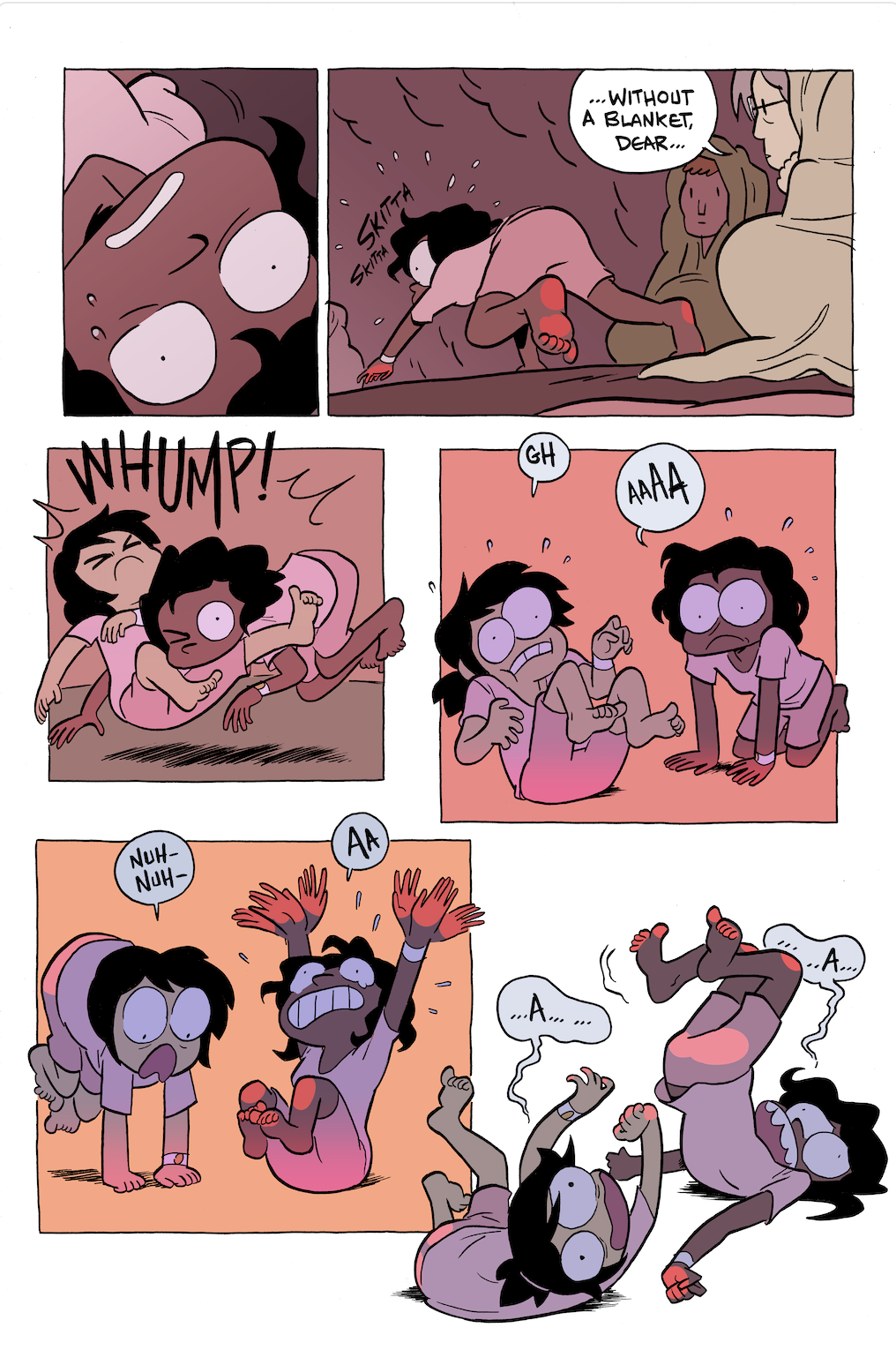
INK Magazine sat down with cartoonist and webcomic expert, Meredith Gran to get an inside opinion on topics from the impact of webcomics in the industry to how to stand out in the World Wide Web. Meredith teaches a course on Webcomics at the School of Visual Arts and has been writing and drawing her webcomic Octopus Pie since 2007. She’s known for her extensive knowledge of the History of Webcomics and her love for Pizza Dog.
What role do you feel webcomics serve in culture?
I think that they are the jumping point for young cartoonists right now, because it’s the most direct, inexpensive way to get your work out there. So culturally it’s very significant because it’s a way that anybody can get their work seen immediately. You don’t need to talk to anybody, you don’t need to speak one word to the world, you can just put your work out there and let it stand the way you want it to be seen. So culturally, it’s breaking down a barrier that used to be set by publishers and editors, so it puts that power into the hands of the creator.
What drew you into the webcomic format?
Meredith: It was pretty much just that. I was very enticed by the idea that I could just get started. I think I started when I was about sixteen, and I just was so impatient, I could not wait to get out of school and just start doing this. And I saw a couple of webcomics online that were essentially syndicated strips that didn’t make it into the paper for whatever reason- whether they were just not suitable for the paper, or the author had tried a million times and nobody had accepted them, so those comics were online and I saw that as just “this is the ultimate opportunity, I can just get started on today on this if I want”. It was the ease of access that really got me into it.
Who are you inspired by?
Lets see...some of my oldest influences are Chuck Jones and Tex Avery, I really like their style of cartooning- the acting they put into their art. I’ve always really liked Matt Groening and the Simpsons, it was sort of a transition from comics to animation, where these iconic characters came out of kind of crappy / weird looking drawings and I always appreciated that it preserved some of that. Maybe not so much anymore but definitely when I was growing up.
How do you feel your animation background gives you a unique perspective into creating comics?
I think I learned a lot about gestures and acting from animation, hitting beats, that there’s sort of a rhythm to these things. With comics a completely different type of rhythm, but looking for those things I feel like I got from animation. That, y’know, if you’re doing storyboards you might kind of be counting these things out in your head, if you’re doing the individual drawings there’s like a little bit of math that you’re doing while you’re drawing each frame. So I think I’ve applied that math to comics in terms of hitting those emotional beats or those joke beats, whatever it might be, I’ve learned a rhythm from that.
What advice do you have for students that are just getting started in comics or webcomics?
I really want to see students just make it….which seems like the most obvious advice ever. But students get so caught up on the details in the beginning. They’re worried about whether they’re doing things the right way or not and it really prevents them from making all the mistakes they need to be making- that aren’t even terrible mistakes. I would rather see a student go straight into it, make all of these wonderful mistakes that are going to immediately improve the quality of their work, and then find that a lot of those things weren’t mistakes, and that those are part of their individual voice.
And on the same kind of thread, what kind of advice do you have for students that are on the cusp of graduation?
Oh boy. Well hopefully they’ve built up a good body of work while they’re here. I would advise them to not be afraid of computers, because every skill they have using any sort of tech that is applied to work right now is going to be very important to them. I would advise them to be open minded, because there are no job descriptions that are descriptions of that person. At some point you may end up creating a job out of your own personal work as a freelancer. But in the very beginning there is no job that’s custom tailored. So being open minded to other people’s needs or clients needs is going to go a long way.
I know that a sort of “hot button cartooning topic” is the transition from traditional media into digital media. A lot of cartoonists are not super happy with digital media because there’s nothing solid and no originals. How do you feel about that?
I think it’s important to know how to do both, I definitely do a combination of each. My process is that I draw everything digitally and then print out the pencils and ink it on paper. And that solves the problem of having originals, which I agree is a big part of the industry for a lot of artists, yknow, having those individual pieces of art you can sell. I think students should be excellent at both. Even if they don’t prefer digital, there are certain things in digital you can only do there, and same with hand drawn comics. If you have a preference that’s wonderful, but you should definitely be a master of all of those tools.
In the comics process which do you think is more important? Writing, or drawing?
The two really work together and I don’t really like to see them separated. Obviously they will be separated if the artist and writer are two different people, but for a cartoonist they’re really taking on the work of an entire film crew. They’re moving the camera around and … y’know, really controlling an entire scene in a way a director does, basically. And a director can’t separate the writing from the direction, those two have to be the same. In terms of the quality of your draftsmanship that I think is less important than the quality of the writing and the ability to tell a good story. You don’t have to be fantastic at anatomy or any specific bits and pieces of drawing, but your art does have to communicate things very clearly. So I think that part is just as important as being a good writer. And then you can always polish that and improve on the art aspect of it from there.
What advantages do you feel that the webcomic format has over a traditional printed format?
The most obvious advantage is that you don’t need to appeal to one of the mass markets that a publisher is looking to appeal to. Even a small press publisher has certain criteria they need to fill in order to sell the book. So being online means that you really can do whatever it is you want to do.
So it’s mostly the freedom behind it?
I would say so, as far as what a publisher does for you, you have to do a lot of those things yourself. So with the freedom comes that responsibility.
Distribution of work can be difficult in a place as saturated as the internet. So what steps do you feel are important in a webcomic to make it stand out in a crowd?
Ah, I would first of all have an excellent website. Whether it’s tumblr or squarespace or homemade or wordpress. Whatever you do - I would have a website where everything is clear and comprehensive, and your eye just instantly hits what it needs to hit, because people have a very short attention span. I would definitely be open minded to cross platform posting, where y’know you post about it on every platform that you are personally active in. If thats twitter, instagram, facebook, whatever it is. You choose that level of interaction that you want to have. But I think the more flexible you are online right now, and the more engaged you are in the communities- y’know actually engaged- not just “I signed up for instagram to promote my comic”, if you are engaged in these platforms, then that would be a good place to promote your work. And really adapt that sort of promotion to the work itself. If your comic is not very nice looking on tumblr, maybe crop the image and show an interesting sample of it. And really make those posts pretty on the platform that they’re supposed to be on. I think that presentation really draws people to it.
Are there any difficulties you feel are particular to the webcomic format in terms of getting a readership?
Well it’s like you said, you are competing for attention on a platform that is increasingly full of people with no attention span. Y’know, clickbaiting is a big thing, the way news is reported in sort of this tantalizing way. You’re part of a feed now. The ”website“ is something that’s sort of taking a backseat to this idea of just having an endless feed of content that you’re going through. People's attention span is just so short. You not only have to capture their attention and keep them around, but you have to remind them non-stop that you still exist. And there’s like that anxiety that comes with it, where you’re just wondering if you’re going to be forgotten about if that next update is taking too long. I don’t know how much of that is real and how much is perceived, but people do forget about you. And keeping them updated in a way that is not intrusive and is gratifying for them, and for you is definitely a challenge.
What changes if any do you think webcomics have made to the comics industry, good or bad?
Alright... so good: I would say, as I said in the beginning, more people than ever are giving this a try. And it's an industry , as most entertainment industries , has been dominated by a white, middle class, heterosexual male. And this [webcomics] has really opened things up to give a voice and a presence to a much more diverse pool of people. So in that regard it's unbeatable for that. In terms of the bad; I think yknow the description of webcomics compared to syndication model, which was how comic strips were monetized 20, 30 years ago, has gone from dollars to pennies. So you don't really have cartoonists who are millionaires anymore. I mean I don't know if that's necessarily a bad thing- I guess you've got penny arcade, they're probably millionaires. you don't have artists being paid substantial amounts of money for their work, there's no real industry built around that. And with that I think you also lose the cultural impact of individual characters. And again I'm not sure if this is good or bad so much as it's, yknow, it's changed. It's good and bad.
I mean for instance we don't have Charlie Brown and Garfield anymore. We don't have characters like that anymore. And that probably ties into the loss of a mono-culture that the Internet has given us- where You don't just need to like the “one big thing” that's popular right now, you can like little subsections - little pockets of culture- that are more tailored to what you want to see. So that's a good thing, but it also means that we lose the impact that comics had on the mass mainstream. So… I yknow, I wish comic artists were better compensated for their work- I feel like with the loss of that part of the industry, there are fewer ways to guarantee that those creators are getting paid. So I’m really hoping with the continuation of all this great work being put out , and more and more people having a serious go at it, we're gonna form some sort of more comprehensive industry around posting your work online.
Why do you make comics? What about the medium inspires you?
I just, it’s so hard to describe because there’s something I just love viscerally about it. I think I love that you get to do everything- when I was a kid I just really enjoyed working on my own- and I noticed comics that does tend to attract people who enjoy working on their own. Yknow, you get to make every judgment call about your own work, you get to do all these things that in film you would have to collaborate on. And I love being able to build that universe. And it’s a really efficient way to build a visual and just yknow, imaginary universe where you can decide what to show- but you can have this whole idea in your head- but you can communicate it with just a few drawings. It doesn’t really cost you any money, apart from the paper and pens, and you can build so much with so little. So I think that’s what I really love about it.
What do you look to for inspiration when you’re stuck in a tight spot, story wise or visual wise?
I really admire Bryan Lee O’Malley, he’s always searching for that next thing. I feel like he’s very critical of his work from a year ago, or 5 seconds ago, or however much time has passed since the last thing he did, he’s always trying to push it and make it a better thing. I feel that way about a couple other of my peers- Kate Beaton is always looking for the next thing, she kind of sees when a device has had its run, when a joke has had its run, and she’s good at evolving past that. Let’s see...who else off the top of my head that I admire that way...? I think K.C. Greene is another example of that, where you can’t pin him down, because he’s always salting the earth when he’s sick of something, and starting something new. So I definitely look to those cartoonists, it’s a medium where you enjoy some success it’s easy to get comfortable and draw the same thing forever, and I feel like those cartoonists, refuse to do that. And that’s something I really admire. I never want to get comfortable doing the same thing. So I look to that.
Lately in the media and in the news there has been a lot of talk about the Angoulême International Comics Festival and sexism in the comics industry in general. Do you feel like we are moving to a place in comics without sexism and how do you think we can get more women and nonbinary people into comics?
I think about this stuff all the time and I don’t always feel very positive about it. On one hand I do feel positive that there is a lot of interest but I worry a lot about these young artists becoming disheartened because things like this seem to keep happening. Yesterday the comics blogger Zainab Akhtar decided she would be quitting her blog, Comics & Cola, and it was mainly because of these mediocre loud mouth men who just are relentless. If you put yourself out there you have to deal with this all the time. On the other hand you have comic artists who are kept in the margins simply [by artists who are] being louder or doing something that is proven to get attention are hogging the spotlight. Which is really frustrating. I think it’s important, and I’ve been watching this wave of internet progressives and I think there is a loss of history that is happening.
I see a lot of people pushing boundaries but also thinking they are the first to do so and I think it's important that we as creators acknowledge the work that has been done. If we look at the history of women in comics a lot of them do get erased. Either by being ignored and just the books not being written about them or they just get sick of it and leave. So as far as interest goes the cartooning program [here at SVA] is at least half women and the attendance here at SVA has to be at least half women so this is a heartening thing. I think it is the retention that we need to be focusing on as a community. Young artists need mentors, they need encouragement, they need places for their work to really shine and our attitudes about these things need to change. The internet promotes both a progressive attitude and a dismissal of the that’s already been done. So I think the context of the history of marginalized people in comics is a very important thing right now and I think that mentoring and encouraging young artists to stick with it despite the daily onslaught of mediocrity is very important.
I like part of that, just to expand on what you’re saying. We forget the history [of comics] and people looking for mentors and not being able to see people like themselves is a part of that I think.
Absolutely, and yeah I’ve noticed that too. People feel more comfortable talking to people with similar experiences as them. So yeah I don’t know the answer to that problem. It seems like at some point a trailblazer has to be the only one doing what they’re doing and they have to endure that hardship that comes with that. And that really sucks, it’s not necessarily pleasant to be a trailblazing artists but i do hope that people don’t get discouraged by the lack of themselves represented in the medium and I hope that they continue to make the comics that they want to see in the world and not let that mediocre voice hold them back from that.
INK would like to thank Meredith Gran for taking the time to be interviewed!
psst! check out the Spring 2016 Issue to see this interview in print…