Gary Panter
Spring 2015 Issue
Interview by INK team
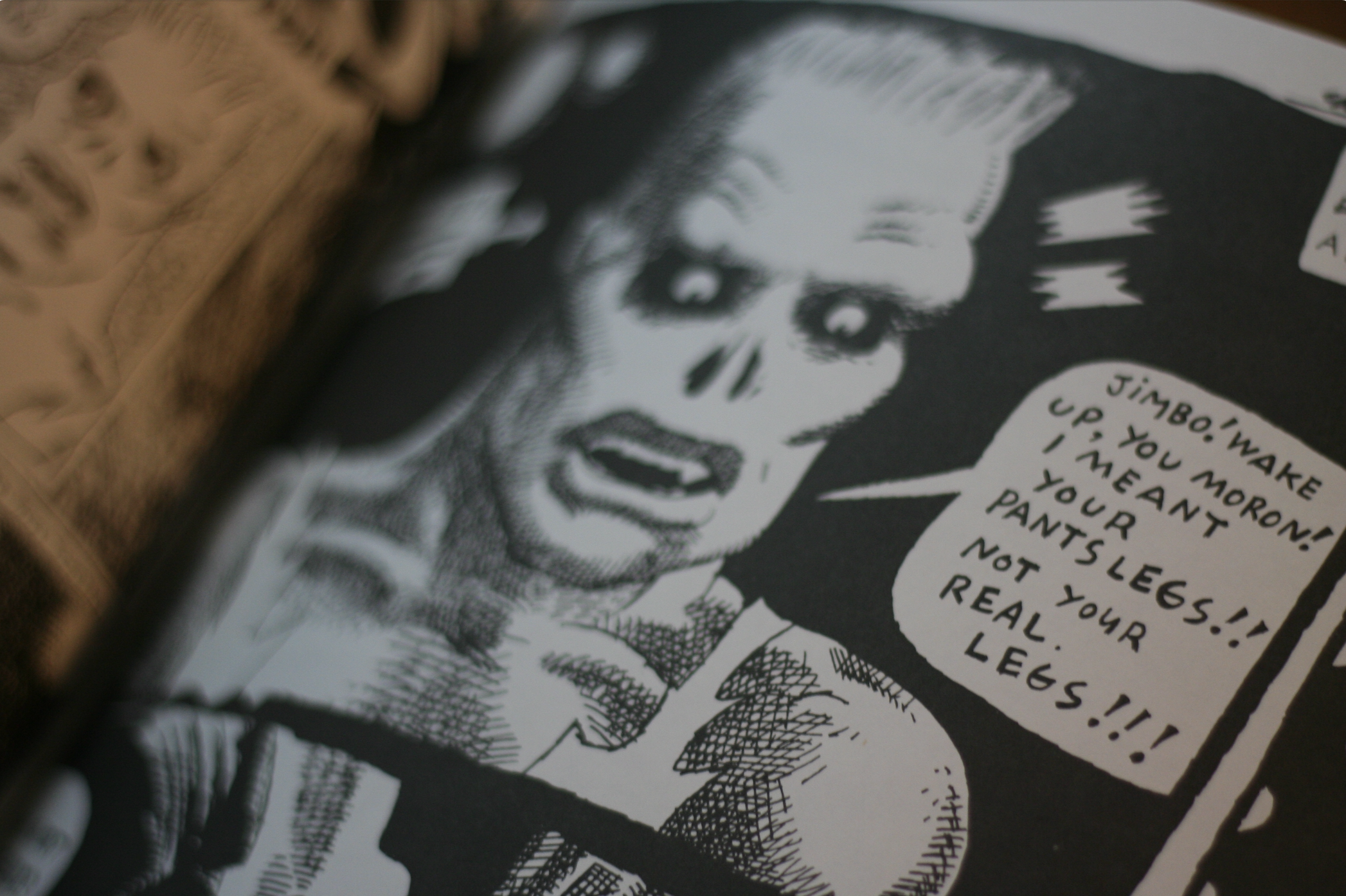
Gary Panter is a cartoonist, illustrator, painter, designer and part-time musician, as well as a teacher at the School of Visual Arts. He’s most well known for his participation in the post-underground, new wave comics movement. His innovative work makes him a popular teacher here at SVA, especially with the editors at INK!
You discovered fine art as a child before getting into comics, right?
Right. I did see comics because my father ran a dime store when I was a child in the 1950's. So he would bring home all these comics. But then we left town in the middle of the night and all the comics were left behind. My dad was a cowboy and Indian painter, and before that we lived in a house trailer full of oil paintings of cowboys and indians, and he kept that up and played drawing games with me when I was little. And so I got interested in painting, and in fifth grade I got painting lessons. I painted a painting of a Kona the Caveman comic with a t-rex, and this was like 1960 or something, at the beginning of pop art - "I was right there!" you know? And the teacher saw me painting this comic book cover and said, "No, you can't do that! That's not art! That's just a comic book cover!" And when parent's day came, she had fixed it up, she had got into working on it a little bit, and that really made me angry.
So I had learned all this oil painting technique, and I did that through high school, and I got into Picasso and modern art. If you look at Picasso, everything's mutating through his whole career and he lives forever. So everyone who's trying to be influenced by him, they're trying to get out from under his wheels and get their own thing going, and you can follow all those paths and that's very interesting. And then it got really interesting in the 1960's when all of these movements just fractured out all over the place, and at that point, when I went into art school in '69, I had already painted giant paintings in high school, 10 by 8 paintings in my garage and making giant abstract art and stuff. When I went to art school they put me with the grad students cause I was this super nerd kid. Around then I finally saw art magazines on a newsstand, I saw ArtForum and I thought it was brilliant because it was so weird. It had like Klaus Oldenburg and Bruce Nauman - strange stuff that was kind of funny. So I was in school studying painting, but at that moment so many things were happening and painting could be anything - it could be performance; it could be digging a hole in the desert, which came from sculpture - and I thought, "It could be comics!" 'Cause I saw hippie comics and thought, "Wow, these are experimental, transgressive, culture-changing, challenging comics." And that seemed like an interesting thing. Also I'd found out about Krazy Kat, which obviously was advanced as Picasso in a lot of ways, and Picasso was a fan. And also, the whole thing with modern art was about breaking new ground, and that was what was happening in the 60's. So to me, the first generation of pop artists were like these painters who had decided, "Wow, there's something in the environment we can paint after abstraction within the abstract point of view." And it was cool - in New York it was cool, it had a detached point of view, and in England it was warmer. But I thought, as a nerd theorist, "Well, the next thing to do would be to put your own comics into media, and then draw your own imagery out and paint it, and see what effect it could have in media, and you could also treat it aesthetically as a different kind of approach." But I didn't like doing that, I didn't like to paint my comics. I could do it, but it seemed icky to me. So I just decided, "Okay, I'm gonna tend to use other people's imagery and keep it more formal and about painting." And the comics, they're really experimental comics so those were difficult, but when I'm not being difficult, it really is about storytelling, clarity, staging, and all the things that comics are. So it's all just rich territory.
When I went to college there were barriers in between everything. "Rock was not like Comics was not like Painting was not like Dance was not like Theater was not like Poetry…" And not the barriers have fallen to a great extent. You can hybridize all of these possibilities now. So it's maybe a more confusing time, there's the danger of too many options maybe, but if you focus on your trip, and keep banging on it, you can be heard.
Do you consider comics to be a narrative medium?
Well, typically they're a narrative medium, but it doesn't have to be. They can be a stage for all kinds of things. That's a thing to me that's so important about being from the past: It's easy to pass over all those art movements that can inform comic activity, like concrete poetry was a giant thing in the 60's which was kinda hokey but had possibilities.
What lessons can cartoonists learn from fine art?
I would say a high aesthetic. Because comics weren't necessarily of a high aesthetic; they could be of an accidental, inspired, intuitive aesthetic, and there were some people who were very high, purposeful aesthetic artists. I'm not sure. Because the bigger conversation about art then evolves, unfortunately, into the stuff I don't like about it which is all this Marxist theory that makes it boring. But then as I start having to talk about that then I start having to talk about the distribution of art and those things I don't like reading about. The thing that clouds art for people is the giant machinery to sell it and to elevate it and that the art is really a baseball trading card for billionaires, who really make the money. Ten artists may also make that much money per decade, but most artists make the art and never get any acclaim, or they make some pieces that get acclaim that they sell for $3000 that then are sold for $3 billion later for the billionaires' collectors club. So those machinations kind of cloud the issues of fine art.
But I do think if cartoonists look at pop art especially and, say, color field painting, you can learn a lot from it.
What still excites you about the 60's?
Now that 50 years have passed, it's a shock, because in my head I'm still a teenager, I'm still a 5 year old in the 50s. As a person interested in sharing information you wanna know what's worth sharing. And this thing that seems worth sharing to me is about the cultural explosion of the 60's which was revolutionary and effective and is seen to have failed but did achieve certain things. The possibility of brewing a moment like that, and of purposefully or accidentally being a part of it, or of recognizing what's happening in your time, is very exciting. There are moments of it that are more exciting than other moments probably, but the 60's was one of those times when there was just this hope. "Oh my god, we can grow our hair a little." Bit by bit, gains were made in loosening up. I'm from this super fundamentalist Christianity where the attitude is, "You're burning in Hell, I'm lucky that I'm going to heaven because I've got the right chant, I've got the right secret stone." And so dismantling that was very important for me, because I was very unhappy as that kind of christian.
What it's all about for me is going into a hemp shop in 1968 on Mount Shasta, California, and seeing things I'd only seen in magazines, which were hippies playing flutes and little lutes, psychedelic records everywhere, silkscreening, weaving, you know, they're all in there doing stuff, and it was full blown.
What interests you about shapes?
Whoa. Gee, that's a good question. One thing I'm interested in is about the minimum amount of information that it takes to transmit an idea. And a shape is an abstraction of that idea. It might be something you use to transmit the idea. In figuration, the simpler the glyph, the more expedient the transmission; Charlie Brown vs. Superman. Okay, one thing is, it's a complex, complicated world. Whether it's real or not, it's very ornate. And in the information age, it's more and more ornate, but it's all temporary, it could be lost any second, the sun flares, everything disappears… And I think what aesthetics does is help you to learn how to see. So if you look at Jean Arp for example: A few simple shapes - two colors, two shapes, three shapes, one color, three colors, four shapes - and it's exceedingly beautiful, and it shows you in a sense how things go together in the world. And that's what's interesting to me about these shapes, or about how things go together and accumulate.
What interests you about color?
Well, I was almost more thinking about color when I was answering the question. It enriches your life. If you're colorblind, then you're living in a monochromatic world or some adjacent thing to that, so your aesthetics are going to be based on that. But if you have a full range of color, gee, it's a beautiful show. Most people you talk to go like, "I don't know how to use color, I'm insecure about color, I don't know where to start with color." But finding out what you love is a good place to start. Like when you're walking down the street you're maybe open to seeing two color combinations, or one color by itself. Ellsworth Kelly's one of the biggest examples of that. One of the most boring looking painters, like, "Oh, a big blue thing. Oh, it's really big. It's really big and it's rectangular and it's blue." But then if you start studying him then you realize that all the colors he's using are from emotional memories and they're very specific, and he probably has like a thousand blues next to each other that he's a specialist in… So I think one thing that happens from being an artist over time is that it changes the way you perceive the world. And hopefully your sensitivity becomes richer and your sense of shapes becomes richer.
When I went to Yale summer school of music and art in 1971, I was trying to be an avant garde cartoonist painter, and all the Yale students were painting still lives and landscapes. "Oh my god, these are the most advanced people in the country and they're painting a bush." But the more I looked at it, the more it was like, "Oh my god…that's really a good bush." There would be a sensitivity to the volume of trees and the shadows and the texture with which they're transmitted, and it's a sensitization. In some ways, it was a conservative thing they were doing. But the people that were good at it were actually enriching their lives. There was one girl there, I don't know where she was from, and for five years she had only drawn, in charcoal, one of those wooden strawberry boxes that she carried with her. And that summer that's all she did, more drawings of that box, and they were mindblowing. they were in every light, every saturation, every angle, every shape…it was totally brilliant. So I think sensitization…if that's a word.
What interests you about Donald Duck?
That's a trick question. Well, there's two parts - maybe three parts. Disney was omnipresent in my childhood. It was the dominant thing. Everything else ranked under Disney. And a lot of that work was a little dead, or it was so workmanlike to achieve the animation you couldn't kind of…grok it. But Carl Barks made the most charming fantastic comics of the ‘50s and all the kids knew it somehow. But I think the omnipresence of Disney in general… When the hippies took acid, they saw Donald Duck. And that's a little scary: "I'm gonna see god…it's Donald Duck. Oh no, it's a hundred thousand Donald Ducks, fused together into a big steam iron."
But, uh. good question… Ducks. It is weird… I also think - and here's a crazy idea - what if, and there is some like Christian physicist who thinks this, and I'm not into that, but: What if our existence makes an impression on time? And all those fucking billions of duck-billed dinosaurs are still hanging around the landscape of our psyches somehow? I mean, think how many duck-billed dinosaurs there were, there were probably 20 million years of duck-billed dinosaurs herding all over the country, all over the world, hadrosaurs, archosaurs, they were all, like, trachodons…sifting through the mud with their duck bills and gradually turning into ducks and platypuses. I'll stop.
What is your impression of having your work been integrated, referenced and mutated in pop culture?
That's a good feeling. I mean, if you're on a strong track, people will be influenced by it. If people are influenced by it, you can think, "Well, maybe I'm on the right track." But if people then do exactly what you're doing, then either it's obsessive that you stay with it, because that's the way you've written yourself, or you move on. And i'm interested in moving on, usually. That's the thing, why I influenced so many people was because I isolated so many ways of doing…like in one illustration and then the next album cover I did another thing and another thing and another thing… So I claimed too much territory for one person to claim because I was just experimenting. So it's not fair. "Why didn't he just draw Nancy and act right!?" But it was really about the style being dictated by the material rather than the other way around. Because most people in the 20th century were trying to isolate some germ that was theirs. I'm Joe Palooka, stay away from it. I'm Popeye, get back. I'm Rauschenberg, I'm this guy. And I think we're in kind of a different world now. But we still have egos.
What possibilities emerge when one disavows the technical aspect of picture-making?
Man. It's pretty hard not to be self-aware. It's pretty hard to be unstructured. You can adopt methods to try and be unstructured, you can like totally take so many drugs you don't know who you are anymore, or you can be driven by art history.
When I entered the market of illustration, all the the super hippies of the sixties and seventies were snorting mountains of cocaine and had tons of people cutting stencils so they could do tighter and tighter and tighter airbrush. And if you wanted to be the better illustrator, you had to be tighter than those guys and bring a new thing to it and I just went the opposite way. I couldn't do airbrush; I could get tight, I could have played that, but I was interested in bathroom graffiti and scrawls and the kids i went to grade school's drawings and so I gravitated to that and then I saw that in art movements like COBRA and so on that used that device…it made me stand out from the pack. So that's what I could gain from it in that point in history, like everyone's trying to be tight, like, "Oh, you can be loose!"
Do you think the dichotomy between the technically proficient and what might be called "amateur" is made up?
Well, I think for humans, there's a natural instinct to try to make something better. "Oh, I made an arrow. It doesn't work so good. If I straighten it out, it'll be better." And then that's economically important - the better the arrow is, the more you eat. And that's where judging art by what it's similar to comes about. People naturally want to be noticed, they want to be revered, typically. If you're better in the contest at getting better, then I understand why that came about. But at a certain point, better is not better anymore, and this is what my problem with - sorry, I always go to fucking LSD in any of these interviews - but the acid trip I had in '73 was conducted at the highest possibility I can imagine of computer generation. It was beyond anything I've seen yet in CGI, and it looked computer-generated. And to me it was cold as hell. It was like "Oh my god, I'm in this place where everything's perfect, yet kind of fucked up. There's no dirt. There's manufactured ash on the floor, carefully arrayed," but it wasn't this anymore [rubs fingers], and I value this.
So in some way, perfectibility, what it's headed for is an abstraction. It's an easy way to rank people, but do you rank people by ideas or by facility? There's a lot of dead facility in the world. There's genius facility and there's dead facility. And there's genius crapola and there's just crap that you don't want to look at. So really it still involves trying to be part of a conversation, maybe…although that's contradicted by the strength of folk art. The weird thing about folk art is that it historically has parallels in the rational purpose of art. You look at 20th century art, there's folk artists doing everything that's happening in fine art in gravestones, in quilts, in papercutting, in all kinds of areas.
I think it's because as a species… [laughs] I think there's a uni-mind. There's like the biological organism which doesn't care about us as individuals. It wants more. More more more more more, too many, millions and millions, you can all die but it's all in the name of propagating the species, and that's one mind. Then there's the idealistic mind, which, say, in the way I was raised-- no one ever said this to me-- like the Holy Spirit, how I imagined the Holy Spirit in the Bible was our quantum entanglement as beings. That we do have a connection between our brains, at a distance or close, and that's a valuable mind. It's a species' mind, not necessarily individuated. And then there's our individual egos, our close alliances, who we think we are; the operation mechanisms that are making our blood flow and all that. So we're really possessed of maybe…I don't know how many minds. Six minds? Ten minds? But we mostly live on our egos. And if you destroy your ego with LSD or something, it's a very dangerous thing to do, that's one thing that happened in the 60s was people becoming so at one with "why bother?"
You have said before that you’ve had experiences where you’ve viewed future events or you’ve had some sort of view of the future.
I would say when I was young and got involved in this fine art thing, one of the points of it seemed to me to be things were unfolding and changing, and if you could get in front of it then you could give people the artifact and be like, “Oh I’m after Rauschenberg, here’s just what comes after Rauschenberg, it’s me, I get the prize,” or whatever it is, “I can provide the cultural artifact that will advance the conversation,” and so that’s kind of a wish to know the future in a way. Young brains can sometimes - 20 year olds can sometimes crack the code I think, being fresh into the world, absorbing everything, and go like, “Here’s the next: *ka-ching*” Not monetarily necessary, but just the thing. So I was in that state of mind, and very confused and conflicted about Christianity, y’know, which is all about death and the afterlife and trading it all, like suffering now and not appreciating now for a better later, y’know, various good and bad things. But it comes back to LSD again.
In the ‘60s with my graduate student friends in college and I had one devastating trip with probably poison acid, probably manufactured by the CIA to make hippies get off of acid which had strychnine and speed in it, and it was a 12 hour amazing horror show of this computer animation like I said that was better than Yogi Bear’s fur in that movie. And also like cycling kinds of things that are happening in ratios that are personal, that are not just like random things, things that are made by me to scare me, I mean literally something going “boo!” to me, which is very scary if it’s coming from inside your mind. Boo was never scary before… “Boo!” “Oh shit!” Then only symbols were happening that were like trauma memory because I was in agony and I was terrified and I was fighting it, and I knew the whole time, or I felt if I wouldn’t fight it, if I would relax, that I might just go into bliss and everything would be great, but since I couldn’t relax then I would just be in this spinning ball of imagery, y’know, and so In that spinning ball of imagery there were all these images that would play out for the rest of my life. And so they’re odd mundane things, they’re very mundane, but when I saw them after the trip: “oh no! there’s that thing I saw! It’s mundane!” It’s something that was already in the world but since I had this trauma memory then I would start to ascribe meaning to it that maybe was there, or maybe not, but the imagery did pop up over time, and it would be odd moments, and that continues… [laughs] to a certain extent which I don’t really wanna talk about because I would say that would be verging on mental illness by some rule.
For example, one of the images I saw on the trip was a big poster of a cubist mule and it said IBIRD. And it was black and white I’d never seen anything like it and it vaguely resembled Shepard Fairey’s work and that crowd that did big paste ups. Before 9/11 I had a studio in Williamsburg and suddenly it was like the Haight Ashbury, which I’m interested in, and it was like, oh there’s all these kids here but there’s no reason they’re here, it’s just empty. Rich kids, more and more rich kids and rich kids and rich kids, and they’re walking down the street and it looks like it could be a cultural moment, but it’s dead and empty, and then that poster went up in my neighborhood, that cubist mule poster I’d seen in 1973 on acid, and on my trip I remembered that I saw it decay over time really fast like time lapse photography. A few weeks later 9/11 happened, and then I saw it decay for the next year until it wasn’t on the wall anymore. So did I make that up? Did I just think that happened? It all certainly seemed real, and there’s probably 40 or 50 other things like that that have happened that, if I see them, I’m like, do I run away or do I move forward or do I be neutral, which is the thing probably to do, is just to be neutral. So that was the price I paid for taking that trip. In a way a lot of the imagery that I experienced on the acid trip were allied to things I experienced around 9/11 which made me feel like the calamity of 9/11 had reverberated into the past. Is that a hippie thought or what? It’s madness and yeah, that’s the way my life seems, but I don’t wanna cultivate that. I’m not particularly superstitious… Well I guess I am a little superstitious, but like ghosts and stuff, those kind of experiences, I don’t necessarily believe in them [laughs]. If you have the experience but you don’t believe in them, you still have the experience.
You've said before that you've spent decades working on a comic only to see a few thousand dollars from its publication. Considering that, is comics worth it?
Well I make as much from my original pages as I do from my big paintings, so that’s where I get money finally. People will pay me a lot of money for original pages and that’s why... No, why I make this stuff is just ‘cause I make it, if I can turn it into money, great, and I make the pages big and nice ‘cause I was always interested in museums, it seems like that’s where they should go. Drawings, [William] Blake drawings, people put ‘em in museums, but, as you know, many cartoonists only work just for print, and nowadays with computers, more and more so, there’s not an artifact, but I only live for the artifact, that’s why I’m always telling my students to make an artifact. It’s worth it just in terms of being alive and being allowed to make the stuff because I don’t have a job, like Helene goes to a job with long hours and I don’t, y’know, I work longer hours, but I love that, I work ‘til 4 in the morning ‘til I drop but it’s fascinating to me. If my brain stopped being fascinated it’d be a tragedy for me and I’ll just be like, ok I’ll watch TV, but that hasn’t happened and I get more and more fascinated until I fall apart [laughs].
INK would like to thank Gary Panter for taking the time to be interviewed!
psst! check out the Spring 2015 Issue to see this interview in print…